CONWAY COUNTY HISTORY MUSUEM
VOICES OF OUR ANCESTORS
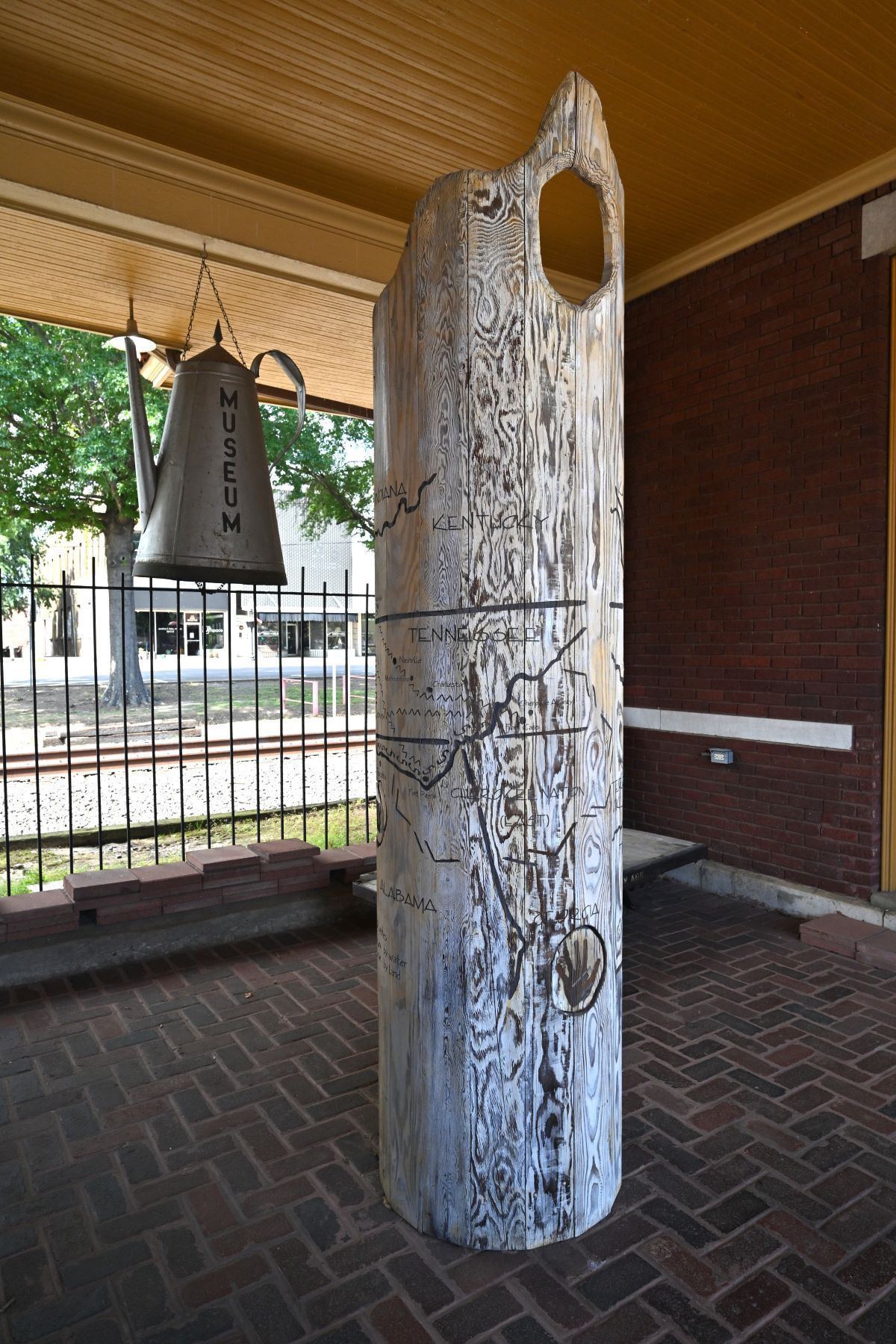
The old Morrilton Depot was originally divided into the freight handling and passenger handling sections, which are now the Genealogy Library and Conway County History Museum, respectively. They are separated by a breezeway, in which you can find this sculpture entitled
Voices of Our Ancestors. It was created by Heidi C Mullins, now Heidi C Powell. It features a representation of the Cherokee Trail of Tears.
In the Artist's Words
"Voices of Our Ancestors is an interactive sculpture that bridges personal lineage, indigenous memory, and local history to honor those forced to travel the Trail of Tears. Originally created for the SOMA sculpture garden in Little Rock, Arkansas, the artwork now permanently resides in the breezeway of the Conway County History Museum in Morrilton, Arkansas, a location deeply connected to the riverways and overland paths taken during Native American removal.
The conceptual foundation of the piece stems from an oral history passed down through generations of my family. During the Trail of Tears, my Lenni Lenape ancestor, a newborn baby named Diodema, was left in a hollow log near the cabin of the Bartlett family near the Tennessee border. The Bartletts took her in, named her Jane, and raised her for seven years until her Native American parents returned from the removal camps to reclaim her into the Indian Nation. This story of resilience, survival, and unexpected human kindness during a period of state-sanctioned hardship serves as the emotional heart of the sculpture.
Formally, the artwork is designed as a hollow tree trunk constructed from Southern Yellow Pine with an internal metal armature, representing the physical log that protected Diodema and symbolizing a living connection between heaven and earth. The trunk features wood cutout openings crafted with handprints reminiscent of indigenous handprints from long past. Viewers are invited to push wooden handprints, activating the internal chimes to create a musical memory with the sound emanating from the open top, giving voice to the spirits of those who walked the Trail.
Etched onto the trunk itself are maps detailing the painful removal routes across Arkansas, including Lewisburg along the Arkansas River.
By merging tangible material culture with intangible memory, Voices of Our Ancestors transforms a devastating historical event into a space for reflection, empathy, and dialogue. It honors the survival of cultural traditions and reminds us that our collective histories are continuously relived through the stories and art we leave behind."
-Heidi C. Powell